
Seven startups join the fifth cohort of an EDC-backed program betting on mission-driven founders.
A new class for KC's social-impact founders
Seven Kansas City companies have been named to the fifth cohort of the LaunchKC Social Venture Studio, an Economic Development Corporation of Kansas City program that pairs $20,000 grants with three months of structured mentorship for entrepreneurs building businesses around social, environmental, or racial impact.
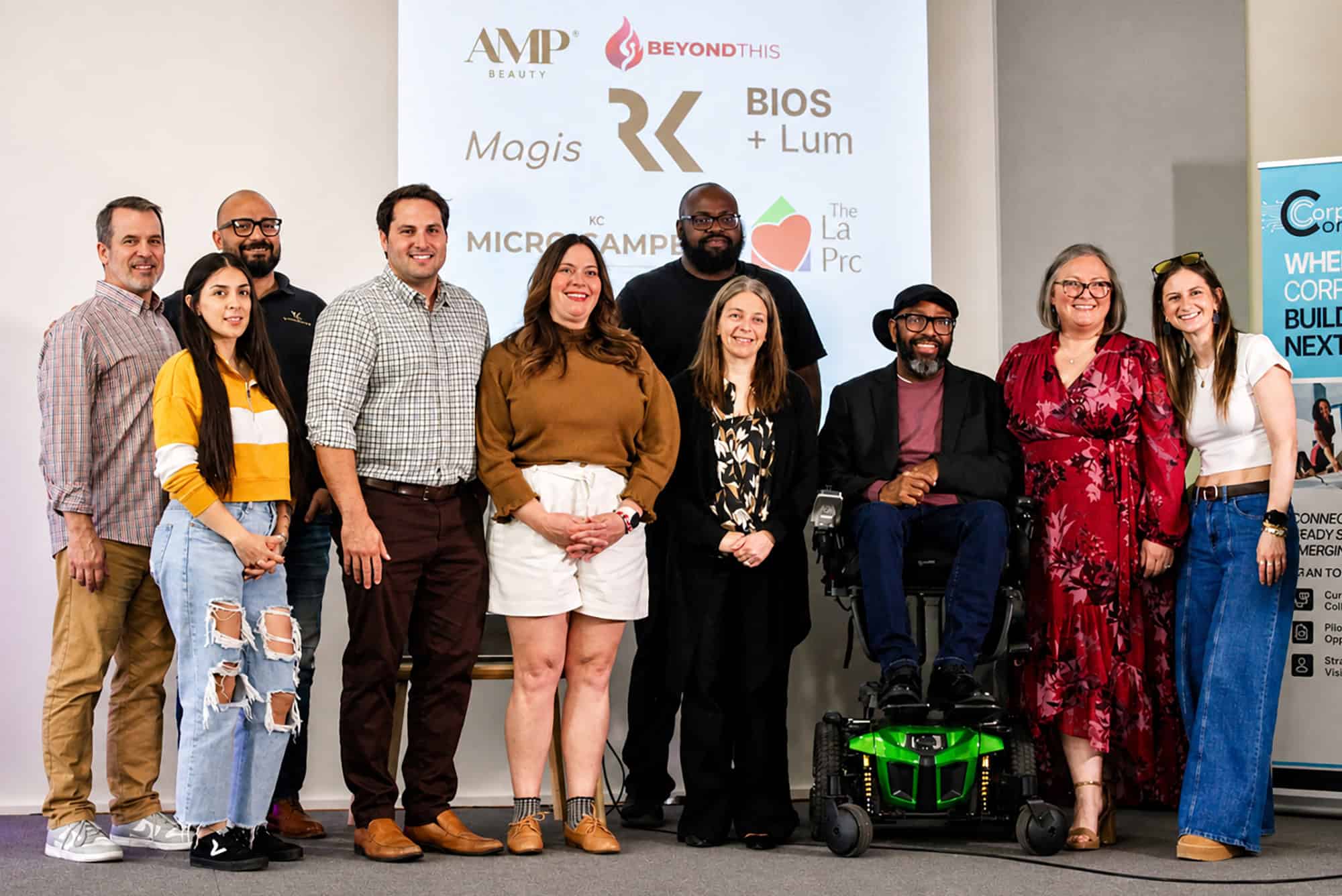
The 2026 class — announced May 1 at the Keystone CoLab in the East Crossroads — brings together founders working on beauty-industry distribution, post-stroke recovery coaching, biodegradable textiles, transitional housing, court analytics, contractor workforce development, and conflict-resolution technology for separated families. Each company receives a grant, temporary office space, and access to the program's mentor and funder network. A culmination pitch event in August will give the cohort its first formal opportunity to present to outside capital.
The Social Venture Studio is a joint initiative of the EDC and the Downtown Council of Kansas City, with programming led by the Keystone Innovation District. Now in its fifth year, the program has graduated 28 companies across four prior cohorts and was honored in 2022 with the International Economic Development Council's Excellence in Economic Development Award for its work promoting economic equity and inclusion.
Why this program looks different
Most early-stage accelerators measure success in valuation multiples, customer counts, and time-to-Series-A. The Social Venture Studio measures something messier: whether a company can hold its mission as it scales. The studio's selection criteria favor founders building solutions to specific community problems — homelessness, recidivism, post-trauma recovery, environmental waste — rather than founders chasing the largest available addressable market.
That shift in framing has consequences for what the program looks like in practice. The grants are smaller than a typical accelerator check, but they come without equity dilution. The mentorship is heavier on operational and systems-design questions than on growth hacking. And the cohort is curated for cross-sector resonance, not vertical concentration.
"We believe this class of companies deserves the policy support, the funding support, the regulatory support, really the ecosystem support, because this is a different type of entrepreneur. This is a different type of founder," said Kevin McGinnis, president and CEO of the Keystone Innovation District, at the May 1 announcement. McGinnis's organization leads programming for the studio, with consulting from Jacqueline Erickson Russell, founder and CEO of Social Impact Advising Group.
Meet the 2026 cohort
The seven companies span sectors from consumer goods to civic technology, and reflect the program's bias toward founders solving problems they have personal proximity to. Two companies are relocating their founders to Kansas City to participate. Each is described below in alphabetical order.
AMP Beauty
Founded by Montre Moore and Angel Lenise Pyles, AMP Beauty is a commerce and technology platform that helps emerging beauty brands scale through retail access, data-driven distribution insights, and multi-channel logistics. The founders are relocating from Los Angeles to participate in the program; they were not present at the May 1 announcement. The company sits at the intersection of consumer goods, retail technology, and founder-equity programs, and its inclusion in the cohort signals the studio's interest in attracting national talent into the KC ecosystem.
Be Aligned by The Layne Project
Founded in January 2025 by Trina Nudson and Tyler Klug, Be Aligned is an evidence-based training and AI-supported technology platform that helps parents and professionals turn conflict into collaboration in separated-family contexts. Nudson, who is also a practicing attorney, framed the company's mission around a public-health framing of family conflict — pointing to the roughly 22 million U.S. children who split time between two homes. "I'm an attorney, and if you turn to a fellow attorney and say, 'I don't know what the hell I'm doing,' they're going to report you to the disciplinary board. If you turn to a fellow founder and say, 'I don't know what the hell I'm doing' — they look at you and they say, 'None of us do. We're just trying to figure this out,'" Nudson said of the program's peer dynamic. She added: "I've fallen down so many damn times. I don't even know how I'm still standing. But I do know it's because of this community."
Beyond This
Founded by Brandon Taylor and Lindsey Taylor, Beyond This is a coaching and support platform that helps individuals and couples reclaim identity, intimacy, and connection after a major stroke or disability. The company emerged from the Taylors' own observation that the U.S. recovery system tends to discharge survivors back into ordinary life without sustained support for relationships. "It's tremendously difficult to go through the recovery process and then leave discharge and have no support for how to become the person you're supposed to be in your new life," Lindsey Taylor said. "So we founded Beyond This to create an ecosystem of support for people who are navigating this journey together with strong conviction that their relationship is so critical to the recovery process that it must be treated as a unit of ongoing care after folks get out of treatment." Brandon Taylor, in his remarks, drew the connection between trauma and intimacy directly: "Trauma tries to steal your person or your identity. So love and intimacy are the only things that heal it."
Biospoke + Lumo
Founded by Nadia Boone, Biospoke + Lumo develops biodegradable textile materials and waste-tracking tools designed to help the fashion industry transition toward circular, sustainable production. Boone is relocating from Detroit to participate in the program and was not present at the May 1 announcement. The company's dual-product structure — a materials business plus a software-based traceability tool — positions it within a growing class of climate-tech ventures that pair physical innovation with data infrastructure.
KC Micro Campers
Founded by Rosana Polanco, KC Micro Campers is the for-profit arm of the nonprofit Embrace Your Shine. The company sells pre-ordered, off-site-fabricated starter homes built using agile-construction methods, with a stated goal of addressing the affordability gap in under-invested Kansas City neighborhoods. Polanco described the studio as a vehicle for tightening the connection between the nonprofit and the development arm: "We're a nonprofit creating transitional housing for young adults facing hidden homelessness while they pursue education or workforce development. So our goal with the Social Venture Studio is to have Embrace Your Shine be the social enterprise of KC Micro Campers and be the development arm." The company is one of two cohort members operating under a hybrid for-profit/nonprofit structure.
Magis
Founded by Courtney Wachal and Thad Diamond, Magis is an AI-powered court analytics platform that helps courts reduce recidivism and secure sustainable funding through evidence-based decision-making. Wachal is a sitting judge whose courtroom approach centers whole-person treatment, including substance use and mental health interventions; Diamond explained that Magis is essentially the software that operationalizes that approach. "What Courtney's courtroom does is it treats the whole person if they have a substance use issue or they have a mental health disorder. It surrounds them with resources for the community... Judge Wachal was having a really hard time measuring what actually was effective in a courtroom, and what kind of interventions might have the most impact in reducing recidivism or just improving the health that the whole person should receive. So that's what our software does," Diamond said. The product sits at a relatively rare intersection: judicial software designed by a sitting judge, sold into a public-sector buyer with structural budget constraints.
RK Contractors
Founded by Reda Ibrahim and Elvis Eneh, RK Contractors is a certified, minority-owned general contracting firm that integrates workforce development and case management into its construction operations to create career pathways for immigrants and refugees. The company has a stated longer-term ambition to build a training center in the Northeast Kansas City corridor. "We have a vision of creating a training center in the Northeast to help people not only to face challenges but educate them through it and try to help them to have a skill in hand," Ibrahim said. "Because with job security, you can fix the economy in the community." RK's inclusion in the cohort signals a broadening of what counts as a "venture" in the program: a workforce-development general contractor sits well outside the typical definition of a startup, but matches the studio's explicit social-impact criteria.
2026 cohort at a glance
| Company | Founders | Sector served |
|---|---|---|
| AMP Beauty | Montre Moore, Angel Lenise Pyles | Beauty retail / commerce technology |
| Be Aligned by The Layne Project | Trina Nudson, Tyler Klug | Family conflict resolution / co-parenting |
| Beyond This | Brandon Taylor, Lindsey Taylor | Post-stroke recovery / intimacy coaching |
| Biospoke + Lumo | Nadia Boone | Sustainable textiles / circular fashion |
| KC Micro Campers | Rosana Polanco | Affordable / transitional housing |
| Magis | Courtney Wachal, Thad Diamond | Court analytics / recidivism reduction |
| RK Contractors | Reda Ibrahim, Elvis Eneh | Construction / immigrant workforce development |
Social venture studios vs. traditional accelerators — how LaunchKC's model differs
| Dimension | Social Venture Studio (LaunchKC SVS) | Traditional Tech Accelerator (e.g. Y Combinator, Techstars model) |
|---|---|---|
| Capital terms | $20,000 grant per cohort company, no equity taken | Investment in exchange for 6–9% equity, typically $125K–$500K |
| Program length | 3 months of mentorship + workshops | 3 months immersive (then ongoing investor-network access) |
| Founder profile | Mission-aligned, often first-time founders building around social, environmental, or racial impact | Tech-first founders building scalable, venture-fundable software / hardware |
| Cohort size | 7 companies in 2026 (cohorts 5–10 historically) | 20–250+ companies per batch |
| Outcome metric emphasized | Sustained community impact + survivable business; not necessarily venture-scale exits | Path to next-round venture funding + 10x+ exit |
| Geographic scope | Kansas City–anchored; relocating-founder welcome (2 of 7 in 2026 cohort are out-of-market) | Hub-city anchored (SF, NYC, Boulder, Tel Aviv) with global founder pipeline |
| Public funding alignment | Coordinated with EDCKC + Downtown Council (Crossroads / Keystone Innovation District placement) | Privately funded; municipal partnerships secondary |
What this cohort signals about KC
Read together, the 2026 cohort tells a particular story about the shape of social entrepreneurship in Kansas City. Three of the seven companies — Be Aligned, Beyond This, and Magis — operate in what could broadly be called "human-systems software": platforms designed to support people navigating high-stakes life transitions, whether that's a family separation, a post-stroke recovery, or a court appearance. Two — KC Micro Campers and RK Contractors — sit in the built-environment economy, with explicit workforce or housing-justice components. One — AMP Beauty — operates in consumer goods and retail technology, and one — Biospoke + Lumo — in materials science and supply-chain transparency.
That distribution looks different from a typical SaaS-heavy accelerator class, and it tracks the program's selection criteria. Most of the founders pitched their companies in language closer to public-health framing than to venture-pitch language. Several described themselves explicitly as first-time startup founders even when they had years of operating experience in adjacent fields. Lindsey Taylor of Beyond This summarized the cohort's expressed motivation: "We're most excited about the resources that we have access to through this program to help us move forward faster and build our partnerships with facilities all around the region."
The Keystone Innovation District's framing — that this is "a different type of founder" who deserves "a different type of ecosystem support" — is also a policy argument. KC's broader entrepreneurial infrastructure has long been weighted toward fintech, ag-tech, and life sciences, areas with relatively well-developed capital pipelines. Social ventures have historically had to bend themselves to fit those pipelines or rely on philanthropic capital. The Social Venture Studio is one of the more explicit local attempts to build a parallel pathway.
What's next
The cohort enters a three-month program that runs through August, when the companies will pitch to potential funders at a culmination event. Between now and then, each company will have access to the studio's mentor network, temporary office space at the Keystone CoLab, and structured programming focused on operations, financial modeling, and partnerships.
The broader arc the program is testing — whether KC can sustain a mission-driven entrepreneurial pipeline distinct from its traditional venture flow — won't be settled by any single cohort. But the studio's track record of 28 prior graduates and a national IEDC award gives the model some institutional credibility heading into year five. As the 2026 class begins programming, the question is less whether mission-driven founders can build viable companies in KC, and more whether the city's funding infrastructure can keep pace with what the studio is producing.
Q: What is the LaunchKC Social Venture Studio?
A: A three-month program operated by the Economic Development Corporation of Kansas City and the Downtown Council, with programming led by the Keystone Innovation District. It awards $20,000 grants and structured mentorship to founders building companies around social, environmental, or racial impact.
Q: How many companies are in the 2026 cohort?
A: Seven: AMP Beauty, Be Aligned by The Layne Project, Beyond This, Biospoke + Lumo, KC Micro Campers, Magis, and RK Contractors.
Q: What does each company receive?
A: A $20,000 grant, three months of structured programming, temporary office space at the Keystone CoLab, and access to the studio's mentor and funder network. A culmination pitch event in August presents the companies to outside capital.
Q: How many companies has the program graduated overall?
A: 28 companies across four prior cohorts. The 2026 class is the program's fifth cohort, and the program received the IEDC Excellence in Economic Development Award in 2022 for its work promoting economic equity and inclusion.