


Joe Ceballos pleads guilty to misdemeanors after being charged with felonies for voting as a noncitizen, ending a high-profile case prosecuted by AG Kris Kobach.
Plea Deal Reached in Coldwater Voter Fraud Case
The former mayor of Coldwater, Kansas, has pleaded guilty to misdemeanor election conduct charges, avoiding jail time in a case that drew national attention. Joe Ceballos, 55, entered a guilty plea to three counts of disorderly election conduct in Comanche County. As part of the agreement, he will pay a $2,000 fine and serve one year of probation.
The resolution marks a significant de-escalation from the six voting-related felonies he was charged with last November—charges that carried the potential for a lengthy prison sentence. Ceballos, who resigned from his mayoral post in December, has consistently maintained that he mistakenly believed he was eligible to vote as a legal permanent resident. The plea deal brings a close to the criminal proceedings against the popular small-town leader.
From Landslide Re-Election to Felony Charges
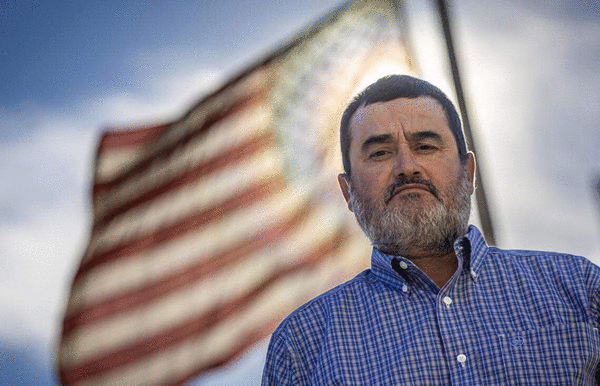
Joe Ceballos, a green card holder born in Mexico who came to the U.S. as a child, was a well-regarded figure in Coldwater, a town of fewer than 700 people. His legal troubles began abruptly just one day after he won a second mayoral term with an overwhelming 83% of the vote. He was charged by the office of Kansas Attorney General Kris Kobach with multiple felonies for voting as a noncitizen.
In interviews with outlets including KCUR, Ceballos described the situation as an honest mistake. He stated he registered to vote many years ago and has participated in every local, state, and national election since 1991, believing his legal residency status permitted it. The charges brought against him were specifically connected to ballots he cast in 2022, 2023, and 2024, according to the Attorney General's office.
A Community Divided: Kobach's Pursuit vs. Local Support
The prosecution was a signature effort for Attorney General Kris Kobach, a national voice for stricter voting laws. In a statement following the plea deal, Kobach said, "This case demonstrates the very real personal and community consequences of having no citizenship verification at the time of registration or indeed at any point in the voting process." He positioned the case as evidence of vulnerabilities in the election system.
This official stance was met with a powerful counter-narrative from Ceballos's own community. According to ArcaMax Publishing, there was an "outpouring of support for Ceballos from the largely conservative town," which rallied around their former mayor. This groundswell of local backing, which saw his actions as an unintentional error rather than malicious fraud, likely played a role in the eventual plea agreement, highlighting a deep divide between legal enforcement and community sentiment.
Why This Matters to Kansas City
Though centered in a small town hours away, the Ceballos case has direct relevance for the Kansas City metro area. It serves as a focal point in the contentious, bi-state debate over election security and immigration policy. AG Kobach's actions signal his office's priorities, which are closely watched by lawmakers, voters, and organizations like the KC Chamber on both sides of the state line.
The case energizes the ongoing discussion about voting laws in both Topeka and Jefferson City. Proponents of stricter measures point to this as proof that illegal voting happens, while opponents argue it represents a heavy-handed prosecution for an honest mistake, wasting state resources on an issue that data suggests is not widespread. For Kansas City residents, this case is a tangible example of the legal and political battles shaping the rules of democracy across the region.
What's Next for Ceballos and Kansas Elections
With the criminal case resolved, Joe Ceballos will focus on completing his one-year probation. A critical question remains regarding his U.S. citizenship application, which he filed in February 2025. It is unclear how this conviction will affect his application or if the Department of Homeland Security will take any action regarding his residency status.
For Kansas, the Attorney General's office has signaled this is not an isolated event. Kobach has stated his office is using the federal SAVE program to identify other potential noncitizens on the voter rolls. "Every time a noncitizen votes, it cancels out a U.S. citizen’s vote," Kobach said in a January statement on a separate case. This suggests that more investigations and prosecutions could be forthcoming, ensuring the debate over voter eligibility remains a hot-button issue in Kansas politics.
Q: What was former Coldwater Mayor Joe Ceballos charged with?
A: Joe Ceballos was initially charged with six felonies, including voter fraud and election perjury, for voting as a non-U.S. citizen.
Q: What was the outcome of the voter fraud case?
A: He reached a plea agreement, pleading guilty to three misdemeanor counts of disorderly election conduct. He was sentenced to one year of probation and a $2,000 fine, avoiding jail time.
Q: Is Joe Ceballos a U.S. citizen?
A: No. He is a legal permanent resident (green card holder) who was born in Mexico and came to the U.S. as a child. He applied for U.S. citizenship in February 2025.